πŸ“HowToHLD
Vote for New Content
Home/High Level Design/Patterns

Sidecar pattern

Learn how the sidecar pattern decouples cross-cutting concerns from your services, how Envoy intercepts traffic transparently, and when to use it over shared libraries.

35 min read2026-03-26mediumsidecarmicroservicesservice-meshkubernetesenvoyhld

TL;DR

  • The sidecar pattern deploys an auxiliary container alongside your main app in the same Kubernetes pod, handling cross-cutting concerns like logging, tracing, TLS, and retries without touching application code.
  • Both containers share a network namespace (localhost) and any mounted volumes. The sidecar intercepts all inbound and outbound traffic using iptables rules, making the proxy transparent to the application.
  • The core trade-off is operational leverage vs. resource overhead: one sidecar image managed by your platform team eliminates infrastructure drift across services, at the cost of ~50MB RAM and ~1-3ms latency per pod.
  • Without sidecars, polyglot teams re-implement logging, tracing, and mTLS independently in each language, and those implementations drift apart over time. With sidecars, those concerns are owned by the platform team and updated without app code changes.
  • The break-even: 3 or more microservices in 2 or more languages. Below that, a shared library is simpler. Above that, shared libraries collapse under governance debt.

The Problem

You're running 18 microservices across Go, Python, and Java. Six teams own those services. Your security team mandates mTLS between all services by Q3. Your observability team wants distributed tracing added everywhere.

Six teams spend six weeks integrating their respective TLS implementations. Three teams mishandle certificate rotation. Two teams ship different versions of the OpenTelemetry SDK. One team's Java service develops a memory leak in the trace exporter. The Go team finishes first, ships to production, and is already a version behind by the time the Python team ships.

Six months later: 18 services, 3 languages, and 18 slightly different implementations of the same 4 infrastructure concerns. Every security audit finds a different CVE in a different version. Every postmortem fights over whose trace was incomplete. Every sprint includes "keep library X up to date across all services" as a recurring ticket nobody wants to own.

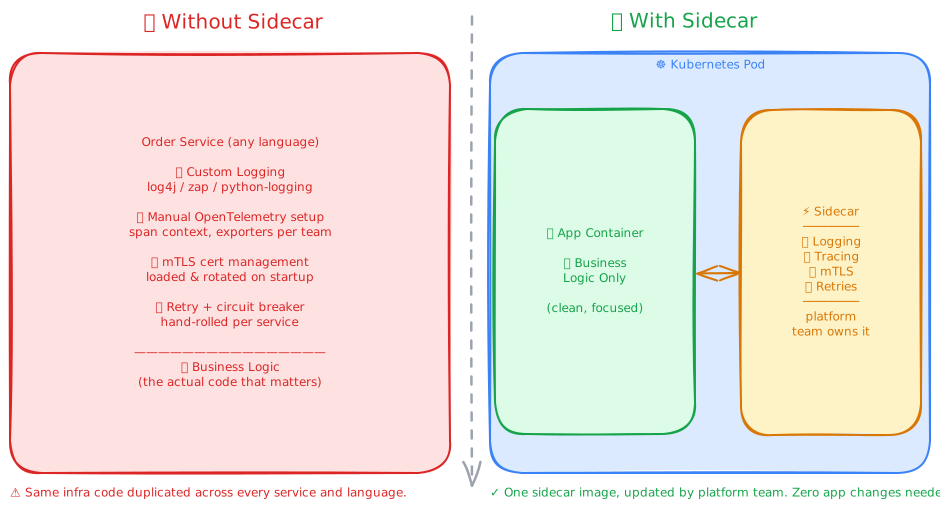
Split diagram comparing a messy service box (without sidecar) containing duplicated logging, tracing, mTLS, and retry code alongside business logic, versus a clean Kubernetes pod (with sidecar) showing a lean app container paired with a separate sidecar that owns all infrastructure concerns.
Without a sidecar, every service is a mixed bag of business logic and infrastructure boilerplate duplicated across teams. With a sidecar, the app container contains only business logic and the platform team owns the rest.

The mistake I see most often is teams treating this as a documentation problem. "We'll write an internal guide and require all teams to follow it." That works for two teams for three months. With ten teams and five languages, it's a governance problem that no amount of code review can fix. The implementation diverges because the incentives diverge.


One-Line Definition

A sidecar co-deploys an auxiliary container with the main application in the same pod, sharing its network and filesystem to transparently handle cross-cutting infrastructure concerns without application code changes.


Analogy

Consider the classic motorcycle sidecar. The motorcycle handles propulsion, steering, and navigation. That is the core function. The sidecar is physically attached and travels everywhere with the motorcycle, but it carries things the motorcycle cannot handle alone: a passenger, luggage, extra cargo.

The motorcycle does not care what is in the sidecar. The sidecar does not control where the motorcycle goes. They share the same journey (the pod), each doing their own job completely.

Your app container is the motorcycle. The sidecar is the attached compartment handling observability, security, and networking. The motorcycle stays focused on getting somewhere. The sidecar handles everything else.


Solution Walkthrough

The shared network namespace

When Kubernetes schedules a pod, all containers in that pod share a single network namespace. This is the key mechanism. Every container in the pod communicates with every other container via localhost.

The sidecar does not need complicated routing to intercept traffic. It is already on the same loopback interface as the main app. An inbound request arrives at the sidecar's listening port, the sidecar processes it (TLS termination, tracing headers, retry policy), and forwards it to localhost:8080 where the app is listening.

From the app's point of view, there is no proxy. Just incoming requests on localhost. The app makes outbound calls normally; the kernel's iptables rules silently redirect them through Envoy before they leave the pod.

Kubernetes pod showing an external HTTP request entering the sidecar container (Envoy Proxy on port 15001), which processes it and forwards it to the app container on localhost:8080. Both containers share a volume for log files.
The shared network namespace makes the sidecar invisible to the app. TLS terminates in the sidecar; the app receives plaintext HTTP on localhost. Both containers write to the shared volume; the sidecar tails and forwards logs.

Traffic interception via iptables (Istio model)

In a service mesh like Istio, the sidecar does not just listen on a specific port. It intercepts all outbound and inbound traffic using iptables NAT rules injected at pod startup via an init container.

The init container runs before both the app and Envoy. It writes rules that redirect all outbound TCP from the pod (except traffic from UID 1337, which is Envoy itself) to Envoy's outbound port 15001. Inbound traffic is redirected to port 15006. The --uid-owner 1337 exemption is critical: without it, Envoy's outbound traffic would be redirected back to itself in an infinite loop.

The application makes normal socket calls. The kernel's network stack silently reroutes every connection through Envoy. This is the "transparent proxy" model.

sequenceDiagram
    participant ExtSvc as 🌐 External Service
    participant InitC as βš™οΈ Init Container
    participant Envoy as ⚑ Envoy Sidecar (UID 1337)
    participant App as πŸ”΅ Your App (:8080)

    Note over InitC: Pod startup β€” runs once and exits
    InitC->>Envoy: iptables: redirect all TCP<br/>except UID 1337 through Envoy

    Note over ExtSvc,App: Every subsequent request
    ExtSvc->>Envoy: Inbound HTTPS :443
    Note over Envoy: TLS termination<br/>Span injection<br/>Retry policy check
    Envoy->>App: HTTP localhost:8080 (plaintext)
    App-->>Envoy: HTTP 200 response
    Note over Envoy: Metrics export<br/>Trace flush<br/>mTLS re-wrap outbound
    Envoy-->>ExtSvc: HTTPS response

For your interview: describe the pod as a unit where app and sidecar share localhost. Name Envoy and Istio. Mention the iptables interception if the interviewer asks how it works. That chain shows you understand the mechanism, not just the abstraction.


Implementation Sketch

Two concrete examples: Docker Compose for local development, Kubernetes for production.

# docker-compose.yml β€” SKETCH
# Illustrates structural relationship. In production, Envoy config is managed
# by the control plane (istiod), not a local file.
services:
  app:
    image: my-order-service:latest
    expose:
      - "8080"               # App listens on 8080; NOT exposed externally
    volumes:
      - logs:/var/log/app    # Shared volume with filebeat sidecar

  envoy:                     # Sidecar 1: networking
    image: envoyproxy/envoy:v1.29-latest
    ports:
      - "80:15001"           # External traffic enters via Envoy, not the app
    volumes:
      - ./envoy.yaml:/etc/envoy/envoy.yaml
    depends_on:
      - app

  filebeat:                  # Sidecar 2: log shipping
    image: elastic/filebeat:8.12.0
    volumes:
      - logs:/var/log/app:ro # Read-only access to the same log volume
      - ./filebeat.yaml:/usr/share/filebeat/filebeat.yml

volumes:
  logs:

In Kubernetes, both sidecars become containers inside a single Pod spec:

# kubernetes/order-service-pod.yaml β€” SKETCH
apiVersion: v1
kind: Pod
metadata:
  name: order-service
spec:
  # Kubernetes 1.28+: initContainers with restartPolicy: Always are "native sidecars"
  # They start before (and stop after) regular containers β€” solving the lifecycle race.
  initContainers:
    - name: istio-proxy
      image: docker.io/istio/proxyv2:1.20.0
      restartPolicy: Always      # <-- K8s 1.28 native sidecar declaration
      args: ["proxy", "sidecar"]
      ports:
        - containerPort: 15001   # outbound traffic redirect target
        - containerPort: 15006   # inbound traffic redirect target
      securityContext:
        runAsUser: 1337          # UID exempted from iptables redirect

  containers:
    - name: order-service
      image: my-order-service:latest
      ports:
        - containerPort: 8080
      volumeMounts:
        - name: shared-logs
          mountPath: /var/log/app

    - name: filebeat
      image: elastic/filebeat:8.12.0
      volumeMounts:
        - name: shared-logs
          mountPath: /var/log/app
          readOnly: true

  volumes:
    - name: shared-logs
      emptyDir: {}

Pre-K8s 1.28: sidecars have no lifecycle guarantee

Before Kubernetes 1.28, sidecars were just regular containers with no guaranteed startup or shutdown ordering. A common production bug: Filebeat exits before the app finishes flushing logs, losing the last N seconds of data on pod shutdown. The workaround is a preStop: exec: ["/bin/sleep", "5"] lifecycle hook on the Filebeat container, which delays its response to SIGTERM long enough to flush remaining log entries before exiting. K8s 1.28 native sidecars (initContainers with restartPolicy: Always) solve this cleanly: they are guaranteed to start before and stop after regular containers.


When It Shines

Ok, but here's the thing most people miss: the sidecar pattern is not a default for any microservices setup. It earns its overhead at a specific scale threshold.

Polyglot teams. The moment you have services in more than one language, a shared library strategy breaks. A Go library and a Python library for mTLS are two separate codebases that drift apart. A sidecar intercepts TCP, not function calls. Language-agnostic by design.

Platform engineering teams. When your company has a dedicated platform team, a sidecar is how that team delivers capabilities without code-level integration. The platform team ships one updated image; product teams get the upgrade with a version tag bump and zero code changes.

Security mandates fleet-wide. mTLS between 50 services is infeasible to implement in application code. One Envoy sidecar config pushed fleet-wide handles it. Each pod gets a SPIFFE identity (spiffe://cluster.local/ns/<ns>/sa/<sa>) embedded in its TLS certificate, issued by istiod's built-in CA β€” the sidecar makes mTLS zero-trust identity, not just encryption.

Consistent distributed tracing. For traces to span service boundaries, the traceparent (W3C standard) header must be forwarded consistently through every hop. Envoy does this automatically at the proxy level. App-level implementations miss headers, use wrong keys, or forget to forward entirely.

The rule of thumb: 3 or more microservices in 2 or more languages and you probably need this. A single monolith or two services in the same language and you almost certainly do not.
Failure Modes & Pitfalls

1. The startup race: app receives traffic before Envoy is ready

This is the most common sidecar production bug on pre-1.28 clusters. When app and Envoy start simultaneously, traffic can arrive at the app before Envoy's iptables rules are configured, before Envoy has connected to the control plane, or before TLS certificates are loaded. The symptom: ~1-5% of requests fail with connection refused or TLS errors during pod startup. The fix: a postStart lifecycle hook that polls localhost:15000/ready (Envoy's admin API) before the app container is marked as started, or upgrade to K8s 1.28 native sidecar containers.

2. Logs lost on pod termination (pre-1.28)

If the Filebeat sidecar exits while the app is still writing logs, the last flush is lost. This produces incomplete crash logs precisely when you need them most. The workaround is a preStop: exec: ["/bin/sleep", "5"] on the Filebeat container: this delays Filebeat's response to SIGTERM, keeping it alive and reading while the app finishes flushing its final log lines.

3. NET_ADMIN capability blocked by security policy

The Istio init container needs NET_ADMIN capability to write iptables rules. In clusters with PodSecurityAdmission in restricted mode or OPA Gatekeeper policies, this capability is blocked. The pod fails to start with a cryptic "iptables: Permission denied" error. Audit your security policies before rolling out Istio to a production cluster.

4. Memory multiplication at scale

Each Envoy instance uses roughly 50MB of RAM. At 1,000 pods, that is 50GB just for sidecars. At 10,000 pods (Uber/Netflix scale), it is 500GB. Baseline Envoy memory grows with xDS route table size; heavily meshed clusters frequently see 150MB per sidecar.

Two alternatives reduce overhead: (1) Linkerd uses ultralight Rust proxies (~10-20MB per pod vs. Envoy at 50-150MB), at the cost of a smaller extension ecosystem; (2) Istio ambient mode eliminates per-pod sidecars entirely, using a per-node ztunnel for L4 mTLS and optional per-namespace waypoint proxies for L7. Before adopting full Istio, audit the RAM cost explicitly and consider whether ambient mode or Linkerd fits your constraints better.

5. Debugging asymmetry: the bug is in the sidecar, not your code

When traces are missing, mTLS handshakes hang, or retries fire incorrectly, developers default to blaming their service. The culprit is often the sidecar configuration. The diagnostic checklist: (1) check Envoy admin API at localhost:15000 first; (2) run istioctl proxy-config to inspect the live xDS config pushed to that pod; (3) only then look at application logs.


Trade-offs

ProsCons
Language-agnostic: any service in any language gets the same infra~50MB RAM overhead per pod, multiplied by pod count
Platform team updates infra without app code changes or redeploys~1-3ms added latency per network hop through the proxy
Consistent observability fleet-wide (same Envoy, same trace format)NET_ADMIN capability required for transparent iptables interception
App containers become simpler: pure business logicDebugging requires knowing two diagnostic surfaces (app + sidecar)
mTLS and cert rotation handled transparentlyStartup race conditions on pre-K8s-1.28 clusters
Log shipping, health adapters, and config sync deployed without buildsAdds operational complexity: the control plane (istiod) becomes critical infrastructure

The fundamental tension here is operational leverage vs. resource overhead. A sidecar is a tax: you pay in RAM, latency, and control-plane operations, and you receive infrastructure uniformity across your fleet. The tax is worth it when your fleet is large and diverse enough that bespoke per-team implementations cost more than the overhead.


Real-World Usage

Uber operates 4,000+ microservices across Go, Java, and Python. Their distributed tracing system (Jaeger) runs primarily via sidecar agents that ship trace data off the critical path. When migrating from their homegrown TChannel RPC framework to gRPC, sidecars handled protocol translation at the proxy level. No upstream services were touched. The non-obvious lesson: a major protocol migration across thousands of services, zero application code changes.

Netflix runs Envoy sidecars across its streaming infrastructure, serving 250+ million members. Before Envoy, Netflix used Hystrix and Ribbon embedded in every Java service. The shift to proxy-level circuit breaking eliminated an entire class of library version drift. The biggest win was not latency or features. It was eliminating the coordination overhead of keeping 200+ services on the same Hystrix release. Operational leverage beats raw performance.

Google, IBM, and Lyft jointly built Istio. Lyft had already open-sourced Envoy in 2016; Istio added the unified control-plane that manages thousands of Envoy instances as a fleet. istiod pushes xDS configuration to every Envoy sidecar simultaneously via a persistent gRPC streaming API, so a fleet-wide policy change propagates in seconds. A routing rule update, a rate-limit policy, a circuit-breaker threshold: all pushed without a single application deployment.


How This Shows Up in Interviews

So when does sidecar come up in interviews, and what depth do you actually need?

It appears most naturally in microservices system design questions: "Design a ride-sharing platform" or "How would you add distributed tracing to 50 services?" A strong candidate mentions sidecars early when these two conditions are true: (1) multiple services in multiple languages, and (2) a cross-cutting concern that every service needs. If you see both, say "I'd use a sidecar pattern here" and briefly explain why before moving on.

Bring it up proactively when:

  • The design has 5+ microservices, or the interviewer says "assume hundreds of services"
  • The question asks about observability, tracing, or service-to-service security
  • The question mentions Kubernetes or "cloud-native architecture"
  • You are designing service mesh infrastructure or routing

Staff-level depth expected:

  • Know the difference between transparent proxy interception (iptables) and explicit proxy configuration (app consciously sends to sidecar's port)
  • Understand the lifecycle coupling problem on pre-K8s-1.28 and the native sidecar solution in 1.28
  • Articulate the DaemonSet vs. sidecar tradeoff and when each is right
  • Know that the xDS protocol exists (the Envoy API used by Istio to push config), even if you do not know it in detail
Interviewer asksStrong answer
"Why not use a shared library?""Shared libraries are language-specific and require restarts to update. If I have 5 languages, I have 5 separate implementations that drift. A sidecar intercepts TCP, not function calls β€” it's language-agnostic. Platform team ships one image; product teams update a version tag."
"What's the overhead?""~50MB RAM per pod and ~1-3ms added latency per hop. At 1,000 pods, that's 50GB for sidecars alone. Worth auditing before committing to Istio at scale."
"How does it intercept traffic without app changes?""An init container writes iptables NAT rules that redirect all outbound TCP (except from UID 1337, which is Envoy) to Envoy's outbound port 15001. The app calls connect() normally; the kernel intercepts it transparently."
"What breaks when the sidecar crashes?""If Envoy dies, all inbound and outbound traffic for that pod fails until Kubernetes restarts it. If Filebeat dies, the app keeps running but logs buffer locally. Design: the app's core function should not depend on sidecar availability."
"Sidecar vs. DaemonSet?""Sidecar when you need per-pod isolation: separate traces per service, per-pod TLS identities, pod-level retries. DaemonSet when the concern is per-node: node-level metrics, host-level log collection, storage plugins. DaemonSet is cheaper (1 pod per node vs. 1 per service) but gives coarser granularity."

Interview tip: name the iptables mechanism

When asked how traffic interception works, skip the vague "it sits alongside and handles traffic." Say: "An init container writes iptables NAT rules. All TCP from the pod is redirected through Envoy port 15001 except traffic from UID 1337, which is Envoy itself β€” so Envoy does not redirect its own outbound traffic in a loop. The app makes normal socket calls; the kernel does the redirection." That sentence separates a strong answer from a generic one.

For your interview: say you would use a sidecar when you have a polyglot microservices environment with cross-cutting concerns that need updating independently of services. Name Envoy. Name Istio. Mention iptables interception if the interviewer probes deeper. Then move on.


Test Your Understanding


Variants

Ambassador pattern

The ambassador is a sidecar that acts specifically as an outbound proxy. It routes outgoing requests from the application to the correct upstream service, handling service discovery, retries, and circuit breaking on the outbound path only.

Where a standard Envoy sidecar handles both inbound and outbound traffic transparently, an ambassador is explicitly configured for outbound concerns. The app calls localhost:9000 (the ambassador's port) and the ambassador resolves the target, applies retry logic, and routes to the correct backend. The app code knows it is talking to a local proxy rather than the remote service directly.

Use the ambassador when your app makes outbound calls to a legacy system with complex routing logic, but you do not want that routing in the app. Common in migration scenarios where the ambassador abstracts an upstream API that is being gradually replaced.

flowchart LR
  subgraph Pod["☸️ Pod"]
    App["πŸ”΅ App\n(calls localhost:9000)"]
    Ambassador["πŸ”€ Ambassador\n(outbound only)\nlocalhost:9000"]
    App -->|"local call"| Ambassador
  end
  Ambassador -->|"resolved route\n+ retries"| Legacy["πŸ—„οΈ Legacy System\nv2 API"]

Adapter pattern

The adapter is a sidecar that translates the app's output into a standardized format for external consumers. The app writes logs in a proprietary format or exposes health metrics over a non-standard protocol (SNMP, JMX). The adapter normalizes the output for Prometheus, Elasticsearch, or your monitoring stack.

Common use case: a legacy service exposes JVM metrics over JMX. Your monitoring stack speaks Prometheus. An adapter sidecar translates JMX output to /metrics in Prometheus exposition format. The legacy service is unchanged. The monitoring team gets data in the format they expect.

The adapter pattern shines during migration: normalize divergent outputs from legacy services without touching the producing service.


Quick Recap

  1. The sidecar pattern co-deploys an auxiliary container in the same Kubernetes pod as the main app, sharing localhost and volumes so cross-cutting concerns (TLS, tracing, log shipping) are transparent to the application.
  2. In Istio, an init container writes iptables NAT rules that redirect all outbound and inbound TCP through Envoy. The critical detail: UID 1337 (Envoy's own UID) is exempted to prevent an infinite redirect loop.
  3. K8s 1.28 native sidecar containers (initContainers with restartPolicy: Always) solved the biggest lifecycle problems: startup ordering and graceful termination ordering. On pre-1.28 clusters, lifecycle hooks are the workaround.
  4. The resource cost is real and compounds: 50MB RAM per pod means 50GB at 1,000 pods and 500GB at 10,000. Factor this into cluster capacity before adopting Istio fleet-wide.
  5. The break-even is roughly 3+ services in 2+ languages. Below that, a shared library is simpler. Above that, shared libraries collapse under upgrade coordination and language boundary friction.
  6. Ambassador (outbound proxy) and Adapter (output normalizer) are variants that solve narrower versions of the problem without full bidirectional traffic interception.
  7. In interviews: name Envoy, describe the iptables interception mechanism, give the 50MB/pod figure, and articulate the DaemonSet vs. sidecar tradeoff. That combination shows you understand the operating model.

Related Patterns

  • Service mesh β€” The service mesh is what emerges when you organize a sidecar fleet behind a unified control plane (Istio, Linkerd). The sidecar is the per-pod component; the mesh is the fleet-wide pattern that manages thousands of sidecars simultaneously via the xDS API.
  • Circuit breaker pattern β€” Circuit breakers are commonly implemented inside the sidecar (Envoy can trip circuits automatically via outlier detection) rather than in application code. Understanding circuit breakers helps you reason about what your service mesh is doing on your behalf.
  • Bulkhead pattern β€” Bulkheads isolate failure domains. Sidecars implement bulkheads at the proxy level by capping concurrent connections per upstream service via Envoy's max_connections and max_pending_requests config β€” no app code required.
  • Microservices β€” The sidecar pattern solves problems that only exist at microservices scale. A single service does not need a sidecar; a fleet of 50 services in 4 languages absolutely does. The pattern is the operational answer to the "polyglot infrastructure" problem that microservices creates.
  • Outbox pattern β€” The outbox pattern handles reliable event delivery without baking reliability logic into app code. Together, sidecar and outbox represent the same design philosophy: separate infrastructure concerns from business logic so each can evolve independently.

Previous

Strangler fig pattern

Next

Outbox pattern

Comments

On This Page

TL;DRThe ProblemOne-Line DefinitionAnalogySolution WalkthroughThe shared network namespaceTraffic interception via iptables (Istio model)Implementation SketchWhen It ShinesFailure Modes & Pitfalls1. The startup race: app receives traffic before Envoy is ready2. Logs lost on pod termination (pre-1.28)3. NET_ADMIN capability blocked by security policy4. Memory multiplication at scale5. Debugging asymmetry: the bug is in the sidecar, not your codeTrade-offsReal-World UsageHow This Shows Up in InterviewsTest Your UnderstandingVariantsAmbassador patternAdapter patternQuick RecapRelated Patterns