๐Ÿ“HowToHLD
Vote for New Content
Home/High Level Design/Concepts

Service mesh

Learn how a service mesh eliminates duplicated networking code across microservices, enforces zero-trust mTLS by default, and gives you end-to-end observability without touching your application code.

42 min read2026-03-24hardservice-meshmicroservicesnetworkingenvoyhld

TL;DR

  • A service mesh is a dedicated infrastructure layer for all service-to-service communication, implemented as sidecar proxies co-located with every service instance.
  • Without a mesh, every team independently implements the same six concerns โ€” auth, retries, timeouts, circuit breaking, metrics, and distributed tracing โ€” producing 50+ divergent implementations inside a 10-service architecture.
  • The data plane is every Envoy proxy in your cluster intercepting traffic. The control plane (Istio, Linkerd, Consul) pushes certificates, routing rules, and policies to those proxies โ€” without touching your service code.
  • Core capabilities: mutual TLS (mTLS) encrypts all east-west traffic by default; traffic management enables canary traffic shifting and instant rollback with zero pod restarts โ€” just change a weight in YAML; circuit breaking is configured as policy, not library code; observability emerges automatically from proxy telemetry.
  • The break-even point is roughly 10 microservices: below that, the operational complexity of running a control plane outweighs the benefits. Above that, the cost of NOT having a mesh grows with every new service you add.

The Problem It Solves

You've just hit 15 microservices. Congratulations. Now look at what every team is doing in their service code.

Team A (User Service) wrote their own retry middleware with exponential backoff โ€” 3 lines in a shared library. Team B (Order Service) wrote theirs from scratch because they missed the library โ€” 47 lines with a subtle bug that retries on client errors. Team C (Payment Service) is using a circuit breaker from a different library than Team D (Inventory Service). Nobody's distributed tracing correlates because they each use a different header format for the trace ID.

And none of it is visible from a single place. When a latency spike hits the Order Service, you can't tell whether it's coming from the User Service, the Inventory Service, or the Payment Service gateway โ€” because each team's observability points only at their own service.

I've seen this pattern at companies from Series B startups to Fortune 50 enterprises. The problem isn't that teams are negligent. The problem is that these cross-cutting concerns are genuinely hard to standardize across teams โ€” and so they don't get standardized until something breaks at 3am.

The hidden cost of Nยฒ duplication

15 services ร— 6 cross-cutting concerns (auth, retries, timeouts, circuit breaking, metrics, tracing) = 90 separate implementations. Each one was correct when written. Two quarters later, they've diverged. The retry logic in your checkout service retries on 503s; the retry logic in your recommendation service doesn't. You discover the inconsistency when a downstream service starts returning 503s during a deploy and checkout loops while recommendations fail fast.
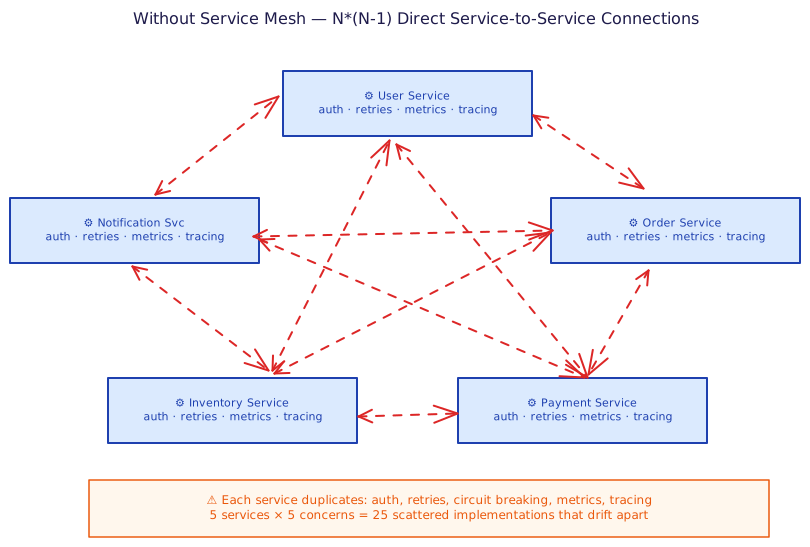
Five microservices (User, Order, Payment, Inventory, Notification) in a pentagon arrangement with direct connections between many pairs. Each service box shows it duplicates auth, retries, metrics, and tracing. Seven red arrows crossing each other show the N-squared connection problem.
Without a service mesh: every service has direct connections to others, and every team duplicates the same six cross-cutting concerns independently โ€” implementations that quietly drift apart over time.

The fix is not another shared library. Shared libraries have the same problem: different services on different versions, and the library can only do what it knows the caller is willing to do. The fix is moving networking concerns out of service code entirely โ€” into the network layer itself.


What Is It?

A service mesh is an infrastructure layer that handles all service-to-service communication in a microservices architecture. It works by deploying a lightweight network proxy โ€” typically Envoy โ€” as a sidecar alongside every service instance. All traffic, both inbound and outbound, is transparently intercepted by this proxy before the service code sees it.

Analogy: Think of an airport. Every flight needs the same things: takeoff clearance, collision avoidance, weather routing, and a landing slot. One option: every pilot manages all of this manually in their own cockpit. The other option: air traffic control handles it for every plane uniformly, and pilots focus on their flight. A service mesh is air traffic control for your microservices. Your services focus on their logic; the mesh handles the networking.

The key word above is transparently. Your service doesn't know the proxy exists. Linux iptables rules in the pod redirect all outbound and inbound traffic to the proxy process (Envoy listens on port 15001 for outbound, 15006 for inbound). Your service code makes a plain HTTP call to http://user-service; the proxy intercepts it, verifies mTLS with the destination proxy, applies retry policy, records a trace span, and emits a metric โ€” all before the bytes leave the pod.

A Kubernetes pod containing two containers: an Envoy sidecar proxy on the left and the application service on the right. Blue arrows show inbound traffic flowing from Service A through the Envoy proxy into the application. Orange dashed arrows show outbound traffic from the application back through Envoy to Service C upstream. Labels list Envoy's capabilities: mTLS, circuit breaking, retries, load balancing, distributed tracing, and metrics.
Every pod in the mesh gets a co-located Envoy proxy. iptables rules redirect all traffic through it transparently โ€” the app service writes zero networking code and cannot distinguish a healthy downstream from a failing one; the proxy handles both.

The result is a clean separation of concerns: service code handles business logic, the network layer handles reliability and security. A team shipping features never touches auth middleware or retry configuration โ€” they declare a policy in YAML, and the control plane distributes it to the right proxies.


How It Works

Every service mesh has two layers working together. Understanding the split is the key to understanding everything else.

The Data Plane

The data plane is every Envoy proxy running in your cluster. It's the layer that actually makes or breaks each individual request. When Service A calls Service B, the sequence is:

  1. Service A makes an outbound call โ€” e.g., GET http://order-service/orders/456. The service code sees nothing unusual.
  2. iptables intercepts the packet โ€” before the SYN packet leaves the pod's network namespace, a rule redirects it to Envoy's outbound listener on port 15001.
  3. Envoy processes the request โ€” the proxy determines the destination (order-service), looks up its current load balancing state (via EDS โ€” Endpoint Discovery Service), applies retry + timeout policy from its xDS config, and initiates a mTLS handshake with the destination-side Envoy.
  4. mTLS handshake completes โ€” both proxies present their SPIFFE certificates (issued by the mesh's Certificate Authority). Both sides are authenticated. The connection is encrypted.
  5. Request arrives at destination proxy โ€” the Order Service's Envoy receives the request and applies inbound policies: is this caller authorized? Is the request rate within allowance? It then proxies the request to the Order Service on localhost.
  6. Order Service responds on localhost โ€” the response travels back through the destination Envoy (which records the response metrics and finishes the trace span) and back through the source Envoy to Service A's code.

Total added latency from two proxy hops: approximately 3โ€“8ms for a typical gRPC or HTTP request. For inter-datacenter calls that already cost 10โ€“50ms, this is negligible. For sub-millisecond in-memory calls, it's not โ€” but those shouldn't be remote calls at all.

# Istio DestinationRule โ€” circuit breaker (outlier detection) + connection pool
# Retries are NOT configured here โ€” use VirtualService for retry policy
apiVersion: networking.istio.io/v1beta1
kind: DestinationRule
metadata:
  name: order-service
spec:
  host: order-service
  trafficPolicy:
    connectionPool:
      tcp:
        maxConnections: 100
      http:
        http1MaxPendingRequests: 50
        maxRequestsPerConnection: 10
    outlierDetection:
      # Circuit breaker: eject hosts with 3 consecutive 5xx errors for 30s
      consecutive5xxErrors: 3
      interval: 10s
      baseEjectionTime: 30s
      maxEjectionPercent: 50
# VirtualService: retry policy for the same destination
# Retry config lives here, not in DestinationRule
apiVersion: networking.istio.io/v1beta1
kind: VirtualService
metadata:
  name: order-service
spec:
  hosts:
    - order-service
  http:
    - retries:
        attempts: 3
        perTryTimeout: 500ms
        retryOn: "5xx,reset,connect-failure"
      route:
        - destination:
            host: order-service

The Control Plane

The control plane manages configuration distribution, certificate lifecycle, and policy enforcement. It never sits in the request path โ€” it's the out-of-band management layer.

In Istio (the most widely deployed mesh), the control plane is a single binary called istiod, which consolidates three functions:

  • Pilot โ€” watches Kubernetes Service/Deployment resources and translates them into Envoy xDS configuration. When a new pod starts or an old one dies, Pilot updates every relevant Envoy's endpoint table within seconds.
  • Citadel โ€” the certificate authority. Issues X.509 SVID certificates to every service (bound to Kubernetes service accounts). Rotates them automatically every 24 hours.
  • Webhook validation โ€” user-submitted Istio CRDs (VirtualServices, DestinationRules) are validated at kubectl apply time via a Kubernetes admission webhook registered by istiod. Misconfigured resources are rejected before they ever reach Pilot. (In Istio < 1.5, this was a separate component called Galley.)
flowchart TD
  subgraph ControlPlane["๐Ÿง  Control Plane โ€” istiod"]
    Pilot["๐Ÿ”€ Pilot\nService discovery\nxDS config distribution"]
    Citadel["๐Ÿ”’ Citadel (CA)\nmTLS cert issuance\n24h auto-rotation"]
    Webhook["โœ… Webhook Validator\nCRD admission (apply time)\nRegistered by istiod"]
  end

  subgraph DataPlane["โšก Data Plane โ€” Envoy Sidecars"]
    subgraph PodA["Pod A โ€” User Service"]
      ProxyA["Envoy :15001/:15006"]
      SvcA["โš™๏ธ User Service :8080"]
    end
    subgraph PodB["Pod B โ€” Order Service"]
      ProxyB["Envoy :15001/:15006"]
      SvcB["โš™๏ธ Order Service :8080"]
    end
    subgraph PodC["Pod C โ€” Payment Service"]
      ProxyC["Envoy :15001/:15006"]
      SvcC["โš™๏ธ Payment Service :8080"]
    end
  end

  Pilot -->|"xDS: routes, endpoints, clusters\n(gRPC stream)"| ProxyA & ProxyB & ProxyC
  Citadel -->|"SVID certs\nauto-rotated every 24h"| ProxyA & ProxyB & ProxyC
  Webhook -->|"Validated CRDs\n(VirtualService, DestinationRule)"| Pilot

  ProxyA -->|"mTLS ยท retried\n~15006 inbound"| SvcA
  ProxyB -->|"mTLS ยท retried"| SvcB
  ProxyC -->|"mTLS ยท retried"| SvcC

  ProxyA -.->|"mTLS east-west\n(encrypted tunnel)"| ProxyB
  ProxyB -.->|"mTLS east-west"| ProxyC

The data plane and control plane communicate via the xDS API (discovery services), an open protocol Envoy implements. This means the control plane doesn't have to be Istio โ€” any system that speaks xDS can manage Envoy proxies. This is why Linkerd (which uses its own proxy) and Consul (which can manage Envoy) both work in different ways.


Key Components

ComponentRoleWhat breaks without it
Sidecar proxyEnvoy or Linkerd-proxy deployed alongside every service instance in the same podNo traffic interception โ€” services must handle networking themselves
Data planeThe collective set of all sidecar proxies making and receiving requestsNo enforcement of policies, no metrics, no mTLS
Control planeManages config distribution (Pilot), certificate issuance (Citadel), and policy validationProxies hold stale routes and stale certificates; new services never learned
SPIFFE/SVIDCryptographic service identity tied to the workload (Kubernetes service account)No way to assert "I am the payment service" โ€” mTLS verification is impossible
Certificate Authority (CA)Issues and rotates X.509 certificates that proxies use for mTLSExpired certs fail handshakes; no cert rotation means one compromised cert is permanent
xDS APIProtocol over which the control plane pushes config updates to proxiesConfig changes require proxy restarts or are never distributed
VirtualServiceIstio CRD declaring traffic routing rules (canary %, header matching, fault injection)No layer-7 traffic management; you're back to DNS-only routing
DestinationRuleIstio CRD declaring connection policies per destination (circuit breaker, retries, mTLS mode)Policies are global instead of per-destination; no circuit breaker declarations

Core Capabilities

Mutual TLS โ€” Zero-Trust by Default

Regular TLS is one-way: the client authenticates the server (you verify the bank's certificate). Mutual TLS (mTLS) requires both sides to present a certificate. The payment service proves it is the payment service; the order service proves it is the order service. No code changes required โ€” the proxies handle the handshake.

sequenceDiagram
    participant A as โš™๏ธ Order Service\n(Envoy proxy)
    participant B as โš™๏ธ Payment Service\n(Envoy proxy)
    participant CA as ๐Ÿ”’ Citadel (CA)

    Note over CA: Certs pre-distributed via SDS<br/>on pod startup. 24h rotation.

    A->>B: TCP connect (port 8080)
    A->>B: ClientHello (TLS 1.3)
    B-->>A: ServerHello + cert (SPIFFE ID: payment-service/sa)
    A->>B: Client cert (SPIFFE ID: order-service/sa)
    Note over A,B: Both verify the other's cert<br/>against the mesh root CA
    A-->>B: TLS handshake complete โ€” encrypted tunnel
    A->>B: HTTP/2 request over mTLS
    B-->>A: HTTP/2 response 200

    Note over A,B: If identity fails AuthorizationPolicy<br/>โ†’ connection rejected (reset)

The practical security implication: a compromised service inside your cluster cannot call the payment service unless it has a valid certificate signed by your mesh CA. Without a mesh, any service that can reach the payment service's port can call it โ€” including an attacker who gained lateral movement after compromising a frontend pod.

mTLS in a service mesh eliminates the need for every service to implement its own token-passing auth. The network layer enforces identity โ€” your application layer just trusts that whoever called it passed the mesh's identity check.

Interview tip: say 'east-west mTLS' specifically

When you mention a service mesh in an interview, immediately say: "I'd enable mTLS for all east-west traffic, which gives every service a cryptographic identity without any code changes." That phrase โ€” east-west mTLS โ€” signals you understand that the mesh handles service-to-service traffic (east-west), not client-to-service traffic (north-south, which the API Gateway handles). The distinction shows operational depth.

Traffic Management โ€” Canary Deployments Without Redeploys

Traffic management rules are declared in VirtualService custom resources and distributed to proxies through the control plane. They enable routing decisions that go well beyond what a load balancer or DNS can do.

# Canary deployment: 10% of traffic to v2, 90% to v1
# No redeploy needed โ€” just change the weights and apply
apiVersion: networking.istio.io/v1beta1
kind: VirtualService
metadata:
  name: payment-service
spec:
  hosts:
    - payment-service
  http:
    - route:
        - destination:
            host: payment-service
            subset: v1
          weight: 90
        - destination:
            host: payment-service
            subset: v2   # new version โ€” getting 10% of real traffic
          weight: 10

---
# Fault injection: test resilience by injecting 5-second delays
apiVersion: networking.istio.io/v1beta1
kind: VirtualService
metadata:
  name: inventory-service-test
spec:
  hosts:
    - inventory-service
  http:
    - fault:
        delay:
          percentage:
            value: 20.0
          fixedDelay: 5s   # 20% of requests get a 5-second delay
      route:
        - destination:
            host: inventory-service

Traffic shifting, header-based routing (send users with X-Beta: true to a canary), and fault injection โ€” these are all zero-code-change operations. You declare intent; the mesh enforces it.

For your interview: say you'll shift traffic incrementally with a VirtualService weight split, monitor the canary's error rate and p99 in the mesh's built-in Grafana dashboard, and roll back by setting the weight back to 0. That's a concrete, operational answer โ€” not "we'd do a canary deployment."

Observability โ€” Metrics and Tracing Without Instrumentation

Every proxy emits the same telemetry for every request: RED metrics (Rate, Errors, Duration) and distributed traces (OpenTelemetry-compatible spans with parent-child relationships).

flowchart TD
  subgraph Proxies["โšก Data Plane โ€” All Envoy Sidecars"]
    PA["Envoy A\nemits: req/s, error%, p50/p99/p99.9"]
    PB["Envoy B\nemits: req/s, error%, p50/p99/p99.9"]
    PC["Envoy C\nemits: req/s, error%, p50/p99/p99.9"]
  end

  subgraph Telemetry["๐Ÿ“Š Observability Stack"]
    Prom["Prometheus\nscrapes :15020/stats"]
    Jaeger["Jaeger / Zipkin\ntrace aggregation"]
    Grafana["Grafana\nservice topology\nlatency heatmaps"]
    Kiali["Kiali\ninteractive service graph\nanomaly detection"]
  end

  PA & PB & PC -->|"Prometheus metrics\nevery 15s"| Prom
  PA & PB & PC -->|"Trace spans\nper request"| Jaeger
  Prom --> Grafana
  Jaeger --> Grafana
  Prom & Jaeger --> Kiali

The critical operational superpower here: you get a full service dependency graph, end-to-end request traces, and per-service error rate dashboards from day one of deploying the mesh โ€” without adding a single line of observability code to any service. The proxies handle it. When a p99 latency spike hits, you open Kiali, click on the affected service, and the service graph shows you exactly which upstream is slow. The trace view shows which function calls are contributing.

I'll often point this out in interviews when asked about debugging microservices: "Because we have a service mesh, I can open the distributed trace and tell you within 30 seconds which service introduced the latency regression." Without a mesh, you're correlating logs from five teams who each format their timestamps differently.

Circuit Breaking โ€” Policy, Not Library Code

Circuit breaking prevents cascading failures by stopping requests to a known-failing service before those requests pile up and exhaust the caller's thread pool.

Without a mesh, every calling service needs to implement a circuit breaker independently, typically via a library like Hystrix, Resilience4j, or tenacity. With a mesh, the circuit breaker is declared in a DestinationRule and enforced by Envoy โ€” zero library code in the service.

stateDiagram-v2
    [*] --> Closed: All traffic passes through
    Closed --> Open: consecutive5xxErrors โ‰ฅ 3\nwithin 10s interval
    Open --> HalfOpen: baseEjectionTime (30s) elapsed
    HalfOpen --> Closed: Request to host succeeds
    HalfOpen --> Open: Request to host fails again

    Closed: โœ… CLOSED\nAll requests forwarded\nto healthy endpoints
    Open: ๐Ÿ”ด OPEN (ejected)\nRequests fail fast\n503 without hitting host
    HalfOpen: ๐ŸŸก HALF-OPEN\nOne probe request\nto test recovery

The mesh's circuit breaker operates at the connection and endpoint level, not the service level. If you have 3 replicas of the order service and one is experiencing 503s, Envoy will eject that specific pod from the load balancing pool after 3 consecutive failures โ€” while continuing to send traffic to the other two healthy replicas. Your callers see stable p99 because the failing replica is ejected before it contributes to the percentile calculation.

This is significantly more targeted than a library-level circuit breaker, which opens at the service level and fails ALL replicas when one is bad.


Implementations

ImplementationProxyControl PlaneBest forAvoid when
IstioEnvoyistiod (Pilot + Citadel + admission webhooks)Full feature set, large orgs, advanced traffic managementSmall teams โ€” operational complexity is real
Linkerdlinkerd-proxy (Rust)Linkerd control planeSimplicity, lower overhead (~10MB vs ~50MB per proxy), Golden path CNCF graduationNeed Envoy's L7 extensibility (WASM filters)
Consul ConnectEnvoy (optional) or built-in proxyConsul serverMulti-cloud, non-Kubernetes workloads, HashiCorp ecosystemPure Kubernetes shops โ€” Istio's K8s integration is tighter
AWS App MeshEnvoyAWS-managed control planeRunning on EKS, want managed control plane, already on AWSMulti-cloud, vendor-neutral requirements
KumaEnvoyKuma control planeMulti-zone (multiple clusters), Kong ecosystemIstio would be simpler for single-cluster K8s

My recommendation: Linkerd for teams adopting a mesh for the first time on Kubernetes. Smaller proxies, simpler operations, and ~95% of the capabilities teams actually need. If you need advanced traffic management (complex canaries, Lua/WASM filters, multi-cluster) or you're running non-Kubernetes workloads, move to Istio.


Trade-offs

ProsCons
Cross-cutting concerns centralized once โ€” not duplicated across every service team~3โ€“8ms additional latency per hop from two proxy invocations
Service code stays clean โ€” no auth, retry, or metrics boilerplate in business logicOperational complexity: new failure domain (control plane) to understand and debug
mTLS by default โ€” zero-trust networking without certificate management in appsResource overhead: each Envoy sidecar uses ~25โ€“50 MB RAM and ~0.5โ€“1% vCPU at idle
Uniform observability (RED metrics, traces) across all services on day oneDebugging harder: when something goes wrong, is it the proxy or the service?
Canary deployments and traffic shifting as a YAML config changeLearning curve: new CRDs, xDS concepts, SPIFFE/SVID, and proxy debug commands
Retroactive: deploy mesh to existing services with zero code changesControl plane is a new availability dependency โ€” istiod crash stops config propagation
Circuit breaking at the endpoint level โ€” ejects bad replicas, not bad servicesTraffic policy misconfiguration is an invisible failure โ€” service ignores mistyped CRD names

The fundamental tension here is operational simplicity vs. consistency at scale. Below 10 services, running a mesh control plane is complexity you don't need โ€” a single shared library handles the common cases. Above 10 services with multiple teams, the library diverges and the mesh becomes cheaper operationally than maintaining coordination between teams. The trade-off isn't technical โ€” it's organizational.


When to Use It / When to Avoid It

So when does a service mesh actually justify its operational cost? The honest answer depends more on your team structure than your service count.

Use a service mesh when:

  • You have 10+ microservices owned by 3+ different teams โ€” this is where shared-library coordination breaks down.
  • You operate in a regulated industry (PCI-DSS, HIPAA, SOC 2) requiring encrypted transit, audit logs of service-to-service calls, and cryptographic proof of caller identity.
  • Canary deployments, A/B traffic routing, or traffic shifting are frequent operations โ€” the mesh makes these zero-downtime config changes.
  • You need end-to-end distributed tracing across all services without mandating a specific tracing library for every team.
  • Your current state: teams are using different libraries for the same concern, breaking your ability to reason about system behavior uniformly.

Avoid a service mesh (or wait) when:

  • You have fewer than 5โ€“8 services or a monolith with a few satellite services. The operational overhead of istiod for 4 services is painful and unnecessary.
  • Your team has never run Kubernetes operators or CRD-based configuration management. Learn to walk before you mesh.
  • Your latency budget is extremely tight (p99 SLO < 5ms for a synchronous call chain). Four hops at 3ms each = 12ms of pure proxy overhead.
  • You're pre-product-market-fit. Mesh adds complexity that slows iteration. Build the product first.
  • Your organization doesn't have anyone oncall who understands Envoy debugging. A misconfigured DestinationRule is completely silent until it reroutes traffic incorrectly at 2am.

The rule of thumb: 3+ teams owning microservices with different tooling choices = you probably need a mesh within the next 12 months. One team owning everything = you don't.

Service mesh vs. API gateway โ€” different problems

The API gateway handles north-south traffic: client requests entering your system from outside. The service mesh handles east-west traffic: service-to-service communication inside your infrastructure. You almost always need both. The gateway handles external auth, rate limiting per client, and API versioning. The mesh handles internal auth (mTLS), inter-service reliability, and observability. They complement each other โ€” they don't replace each other.


Real-World Examples

Lyft โ€” born from the pain of 150+ microservices

In 2015-2016, Lyft was operating ~150 microservices and experiencing exactly the problem described above: every team had their own networking code, debugging was nearly impossible, and operational incidents were impossible to trace to a root service. They built Envoy internally to solve it โ€” a single C++ proxy that handled all of Lyft's service-to-service traffic with uniform observability. After open-sourcing Envoy in 2016, it became the most widely deployed L7 proxy in cloud-native infrastructure. Today, Lyft's mesh handles millions of requests per second across hundreds of services, and every one of those requests generates a trace span โ€” giving their on-call engineers a service dependency graph that would have taken years to build manually.

The lesson: the need for a service mesh isn't a sign of engineering weakness. It's a sign that your organization has grown complex enough that informal coordination fails.

Google โ€” Istio and the 10-year internal precedent

Google's internal infrastructure ran a service mesh equivalent โ€” Stubby, later migrated to gRPC โ€” for over a decade before open-sourcing Istio in 2017. Inside Google, every service-to-service call was authenticated, encrypted, and observable by default. When Kubernetes became the dominant container orchestration platform outside Google, their engineers designed Istio to bring the same guarantees to the broader community. Google's own production GCP infrastructure runs Istio internally for its managed Kubernetes (GKE) cluster-to-cluster communication. The scale โ€” millions of containers, thousands of clusters โ€” demonstrates that the control plane itself can be kept highly available and reliable when operated correctly.

The lesson: zero-trust east-west networking isn't a luxury feature. At organizations with Google's security requirements, it's table stakes. A service mesh is the only practical way to enforce it at scale.

Spotify โ€” 400+ microservices, Backstage, and why they kept it simple

Spotify operates 400+ microservices across their backend. Rather than adopting Istio's full feature set, they chose a more incremental path: they built their own internal service mesh primitives using Envoy as the proxy but with a lighter-weight control plane. Their key finding: the most valuable capabilities are mTLS and observability (distributed tracing and RED metrics). Circuit breaking and advanced traffic management were used by fewer than 10% of their services. By optimizing for the common case and making the mesh operationally simple, they achieved 100% mTLS coverage across all services within one quarter โ€” without requiring any service team to change a single line of code.

The lesson: don't over-engineer the mesh. mTLS + observability delivers 80% of the value. Advanced traffic management is real but incremental. Prioritize in that order.


How This Shows Up in Interviews

Here's the honest answer on what separates people who've actually run a service mesh from people who've only read about one: operational specifics.

A candidate who says "I'd add a service mesh for service-to-service security" is describing a feature. A candidate who says "I'd deploy Istio with mTLS in STRICT mode across all services, enforce AuthorizationPolicies tied to Kubernetes service accounts, and monitor istiod CPU so control plane load doesn't spike during rolling deploys" is describing a system they've operated.

My recommendation: when you mention a service mesh in an interview, immediately follow it with the scale trigger (10+ services), the specific capability you're adding it for (mTLS for zero-trust east-west, or observability for distributed tracing), and one operational caveat (proxy overhead, or the need for control plane HA).

When to bring it up proactively

Mention a service mesh proactively when the interviewer asks how you'd handle security or observability in a microservices design. Say: "Once we're past 10 services, I'd deploy a service mesh โ€” specifically to enforce mTLS for east-west traffic and to get uniform distributed tracing without mandating a specific client library." That sentence shows you know the scale trigger, the specific capability, and the organizational benefit. Three things in one sentence.

The inverse mistake is equally common. Placing the mesh at the edge โ€” as if it were an API gateway โ€” reveals a conceptual gap that follows you through the rest of the answer.

Don't conflate the API gateway and the service mesh

The most common mistake I see in system design interviews is placing the service mesh at the ingress layer or confusing it with the API gateway. Be precise: "The API gateway handles north-south traffic โ€” external clients entering the system. The mesh handles east-west โ€” service-to-service calls inside the cluster." One interviewer question will expose it; answer it before they ask.

Depth expected at senior/staff level:

  • Name the data plane vs. control plane split: "Envoy handles the requests (data plane); istiod distributes config and certs (control plane). They're separated so control plane downtime doesn't stop traffic from flowing."
  • Explain how mTLS works without libraries: "iptables redirects all pod traffic to Envoy; Envoy does the TLS handshake with the destination's Envoy. The application code makes a plain HTTP call and never knows mTLS is happening."
  • Name the circuit breaking mechanism precisely: "Envoy's outlierDetection ejects individual pod endpoints that exceed a consecutive failure threshold โ€” not the whole service, just the bad replica."
  • Know the control plane HA requirement: "istiod must be HA โ€” at least 2 replicas. If istiod crashes, existing proxies keep running with their last-known config, but new pods won't get certs and config changes won't propagate."
  • Distinguish mesh implementations by tradeoff: "Linkerd is simpler with less overhead, Istio has the full feature set. For most teams, start with Linkerd unless you need advanced traffic management or non-Kubernetes support."

Common follow-up questions and strong answers:

Interviewer asksStrong answer
"What's the latency overhead of a service mesh?""Two proxy hops add ~3โ€“8ms per request. For services making remote calls that already cost 10โ€“50ms, this is negligible. For super-latency-sensitive paths (< 5ms SLO), consider bypassing the mesh for that specific service pair with an allow-list, or using a lighter proxy like Linkerd (~0.5ms per hop)."
"How does mTLS work without changing service code?""iptables rules in each pod redirect all traffic to Envoy before it leaves the network namespace. Envoy performs the mTLS handshake with the destination Envoy. The application makes plain HTTP; it never knows TLS is involved. Certificate rotation also happens via Envoy โ€” Citadel pushes a new cert to the proxy without restarting the service."
"What happens if the control plane (istiod) goes down?""Existing proxies continue using their last-known configuration โ€” traffic keeps flowing. The impact is: new pods won't receive certificates (can't join mTLS), config changes won't propagate, and certificate renewals will fail after ~24 hours if istiod is still down. Run istiod with 2+ replicas on dedicated nodes to avoid this. It's a high-availability requirement, not optional."
"How would you do a canary deployment with a service mesh?""Deploy the canary as a new Deployment with a different version label. Create a DestinationRule with two subsets (v1 and v2) using label selectors. Apply a VirtualService shifting 5% weight to v2. Monitor error rate and p99 in the mesh's Grafana dashboard. Increase weight in increments. Roll back by setting v2 weight to 0 โ€” no pod restarts, no DNS changes."
"How does the mesh handle certificate rotation without downtime?""Citadel issues 24-hour certificates. Before expiry, it pushes a new cert to Envoy via the SDS (Secret Discovery Service) API โ€” a push-based gRPC stream the proxy maintains with istiod. The proxy can hold both old and new certificates simultaneously, completing in-flight requests under the old cert while starting new connections with the new cert. Zero downtime, handled entirely by the control plane."

Test Your Understanding


Quick Recap

  1. A service mesh is a dedicated infrastructure layer for service-to-service communication, implemented as sidecar proxies (Envoy or Linkerd-proxy) co-located with every service instance โ€” zero application code changes required.
  2. The data plane (all Envoy proxies) handles every individual request: mTLS handshakes, retries, circuit breaking, load balancing, and telemetry emission. The control plane (istiod) distributes certificates and config to those proxies without sitting in the request path.
  3. Control plane downtime doesn't stop traffic โ€” existing proxies run from cached config. The two failure risks are: new pod cert issuance stalls, and pending cert rotations miss their window if the outage outlasts the cert's remaining lifetime.
  4. The break-even point for adopting a mesh is approximately 10+ services owned by 3+ teams โ€” below that, a shared library handles the common cases at lower operational cost.
  5. Mutual TLS (mTLS) in STRICT mode gives every service a cryptographic identity, encrypts all east-west traffic, and enables AuthorizationPolicies that reject lateral movement โ€” all without your application code knowing TLS exists.
  6. Istio is the full-featured choice for large organizations needing advanced traffic management; Linkerd is the simpler, lower-overhead choice for teams adopting a mesh for the first time.
  7. In an interview, mentioning "east-west mTLS via service mesh" paired with the scale trigger (10 services, multiple teams) and one operational detail (istiod HA requirement, or proxy latency overhead) reliably signals staff-level familiarity โ€” not just awareness.

Related Concepts

  • Microservices โ€” The architectural pattern that generates the problem a service mesh solves. Understanding why microservices create coordination overhead is prerequisite context for understanding why the mesh investments pays off.
  • API Gateway โ€” Handles north-south traffic (external clients entering the system) while the mesh handles east-west (internal service-to-service). You almost always run both, and knowing where each one's responsibility ends is a common interview follow-up.
  • Circuit Breaker โ€” The service mesh's circuit breaking capability is the infrastructure-layer implementation of this pattern. Understanding the pattern in its library form first makes the mesh's policy-as-config version much easier to reason about.
  • Load Balancing โ€” The mesh's Envoy proxies implement L7 load balancing at every hop (round-robin, least-request, consistent hash) โ€” more capable than the L4 load balancing of traditional hardware LBs. Understanding load balancing helps you explain why the mesh's endpoint-level circuit breaking is more precise than service-level circuit breaking.
  • Rate Limiting โ€” Service meshes can enforce per-service rate limits at the proxy layer via Envoy's rate limiting filter, but the mesh's built-in rate limiting is simpler and less flexible than a dedicated rate limiting service. Understand where the mesh's limits (pun intended) are.

Previous

Microservices

Next

Networking

Comments

On This Page

TL;DRThe Problem It SolvesWhat Is It?How It WorksThe Data PlaneThe Control PlaneKey ComponentsCore CapabilitiesMutual TLS โ€” Zero-Trust by DefaultTraffic Management โ€” Canary Deployments Without RedeploysObservability โ€” Metrics and Tracing Without InstrumentationCircuit Breaking โ€” Policy, Not Library CodeImplementationsTrade-offsWhen to Use It / When to Avoid ItReal-World ExamplesHow This Shows Up in InterviewsTest Your UnderstandingQuick RecapRelated Concepts