πŸ“HowToHLD
Vote for New Content
Home/High Level Design/Patterns

Bulkhead pattern

Learn how the bulkhead pattern isolates resource pools to contain failuresβ€”so one slow dependency can never exhaust your thread pool and take down every unrelated feature.

49 min read2026-03-26mediumbulkheadresiliencemicroservicesfault-tolerancehld

TL;DR

  • The bulkhead pattern partitions your shared resources (thread pools, connection pools, semaphore permits) into isolated compartments β€” one per dependency or feature β€” so exhaustion in one compartment cannot spread to another.
  • Without it, a single slow downstream service can consume every thread in your process. Your search, checkout, auth, and home feed all return 503 β€” not because they are broken, but because the broken payment service ate all 200 threads.
  • Three implementation flavours: thread pool isolation (separate executor per call type), semaphore isolation (permit cap per feature), and connection pool isolation (separate pools per workload).
  • Pair with a circuit breaker: bulkheads contain blast radius inside your process; circuit breakers contain blast radius across the network. You need both.
  • The fundamental tension: resource efficiency vs. isolation. Bulkheads pre-allocate resources that sit idle when their workload is light β€” the price you pay for guaranteed protection.

The Problem

It's 11 p.m. Your on-call phone lights up. Every page on your e-commerce platform is timing out β€” product listing, checkout, user profile, search. The CEO's evening browse session is dead. You pull up dashboards and see something strange: CPU is fine, memory is fine, network is fine. But the Payment Service is throwing 500s due to a database failover.

Wait. Why is payment taking down search?

Your Order Service calls three downstream services on every request: Inventory, Recommendations, and Payment. They all share one thread pool β€” 200 threads total. Payment's database is in failover; queries hang for 30 seconds. With 200 concurrent checkout requests, all 200 threads are occupied waiting on Payment. The thread pool is exhausted. A new request for the innocuous homepage arrives β€” it needs Inventory data, has nothing to do with Payment β€” but there are no threads to serve it. It times out too.
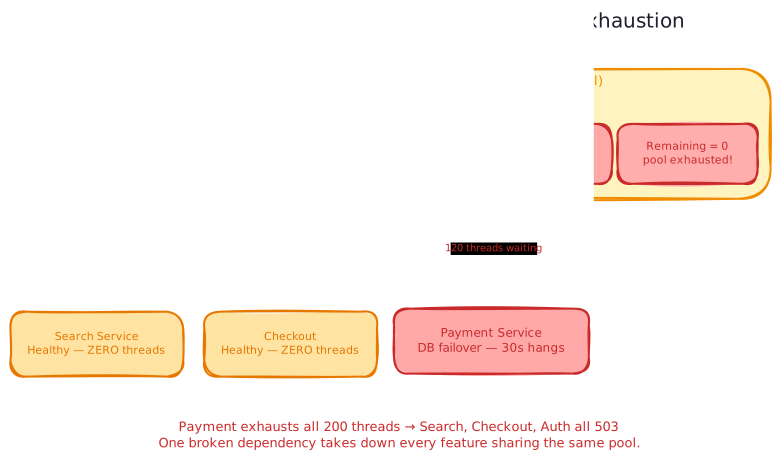
Diagram showing one shared thread pool of 200 threads. Payment service consumes 120 threads waiting on a slow DB. Search and Checkout threads show zero remaining, even though those services are healthy.
Payment's DB failover steals every thread in the shared pool. Search, Checkout, and Auth return 503 β€” not because they're broken, but because they have no threads left to run on.

The fix isn't more threads β€” it's isolation. The ship didn't sink because of a single hull breach. It sank because the water could flow freely between compartments.


One-Line Definition

The bulkhead pattern partitions shared resources into isolated pools so that exhaustion in one pool is physically contained and cannot cascade to other pools.


Analogy

A ship's hull has compartments separated by watertight bulkheads. If one compartment floods β€” say, from a torpedo hit β€” the water cannot flow to adjacent compartments. The ship stays afloat with partial functionality β€” the flooded compartment is lost, but the rest of the vessel continues operating.

Without bulkheads, water entering anywhere flows everywhere. One breach sinks the whole ship.

Your application's thread pool is the hull. Each downstream dependency is a potential flood point. If one of them starts hanging, threads accumulate waiting for its response β€” and without compartment walls, they drain the entire pool until there's nothing left for any other compartment to float on.


Solution Walkthrough

There are three mechanisms to implement this isolation. Which one you reach for depends on your runtime and what kind of resource you're protecting.

Thread Pool Isolation

Assign a dedicated, fixed-size thread pool (executor) to each downstream service you call. Requests for Payment go to the Payment executor. Requests for Inventory go to the Inventory executor. If the Payment executor's 20 threads are all stuck waiting for a slow DB, that's the payment executor's problem β€” the Inventory executor's 20 threads are untouched.
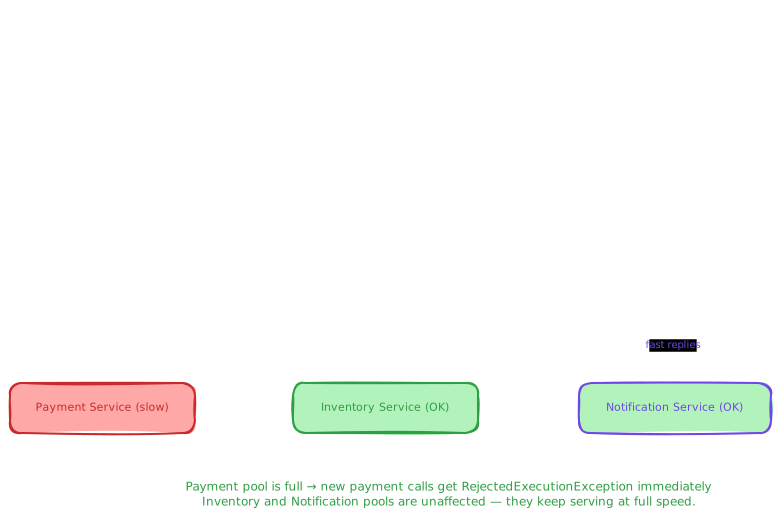
Caller service dispatches to three separate thread pools: PaymentExecutor (20 threads, full from slow dep), InventoryExecutor (20 threads, healthy), NotifExecutor (10 threads, healthy). Overflow gets RejectedExecutionException immediately.
Thread pool isolation gives each downstream its own executor. A full payment pool immediately rejects new calls β€” instead of queuing them into the shared system pool β€” preserving the inventory and notification executors at full capacity.
// thread-pool-bulkhead.ts β€” SKETCH using async concurrency control
// Important: Node.js is single-threaded. p-queue limits *concurrent* async operations
// on the event loop β€” it behaves like a semaphore, not a true thread pool.
// For genuine thread pool isolation in Node.js, use Piscina (worker_threads pool).
// In JVM, use Resilience4j's ThreadPoolBulkhead or Hystrix command groups.

// Shared error class β€” define once, use across all bulkheads
class BulkheadFullError extends Error {
  constructor(message: string) {
    super(message);
    this.name = 'BulkheadFullError';
  }
}

import PQueue from 'p-queue'; // npm install p-queue

const paymentQueue = new PQueue({ concurrency: 20 }); // max 20 concurrent
const inventoryQueue = new PQueue({ concurrency: 30 });
const notifQueue = new PQueue({ concurrency: 10 });

async function callPayment(orderId: string): Promise<PaymentResult> {
  if (paymentQueue.size >= 50) {
    // Queue depth guard: fail-fast if backlog is already deep
    // p-queue: .size = tasks WAITING in queue; .pending = currently running (bounded by concurrency)
    throw new BulkheadFullError('Payment bulkhead queue full');
  }
  return paymentQueue.add(() => paymentClient.charge(orderId));
}

async function callInventory(productId: string): Promise<InventoryResult> {
  // Inventory pool unaffected even if payment pool is saturated
  return inventoryQueue.add(() => inventoryClient.checkStock(productId));
}

Thread pool isolation has real overhead β€” don't apply it to everything

Each call context-switches to a worker thread. In JVM runtimes (Hystrix, Resilience4j ThreadPoolBulkhead), that's ~1ms per call. At 50K req/s with 5 downstream calls per request, you're adding 250K context switches per second. Thread pool isolation is for calls to slow, unreliable dependencies β€” not fast in-process calls or calls with sub-millisecond round-trip time. Apply it surgically.

Semaphore Isolation

A semaphore is a permit counter. You pre-allocate N permits for a feature. Each incoming request acquires one permit before proceeding. When all N permits are in-use, the next request gets an immediate rejection β€” no waiting, no thread spin. When a request completes, it releases its permit back to the pool.
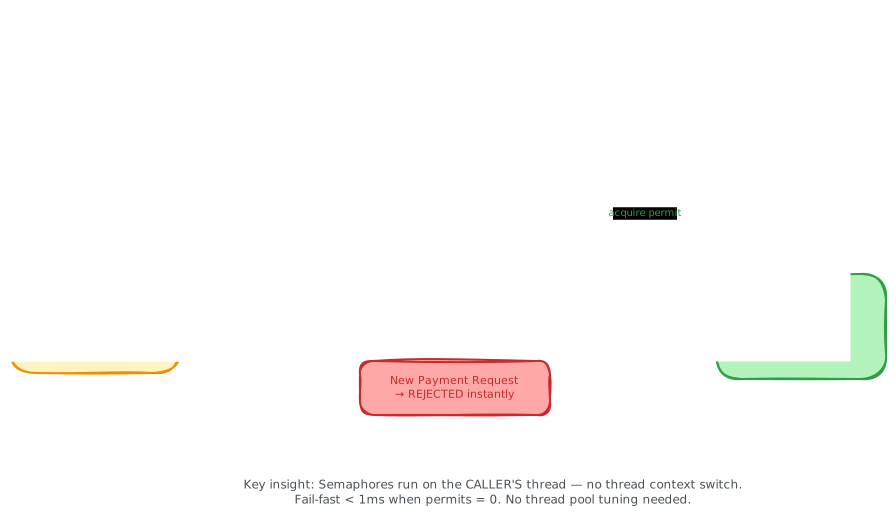
Three semaphores: Search (30 permits, 5 in use), Payment (10 permits, 10 in use - FULL), Notification (20 permits, 3 in use). A new Payment request arrives and is rejected immediately.
Semaphores run on the caller's own thread β€” no context switch. When Payment's 10 permits are exhausted, the 11th request fails in under 0.1ms. Search and Notification semaphores are completely unaffected.
// semaphore-bulkhead.ts β€” lightweight permit-based concurrency limiter
class SemaphoreBulkhead {
  private inFlight = 0;

  constructor(
    private readonly name: string,
    private readonly maxConcurrent: number
  ) {}

  async execute<T>(fn: () => Promise<T>): Promise<T> {
    if (this.inFlight >= this.maxConcurrent) {
      // Fail-fast: no blocking, no waiting. < 0.1ms.
      throw new BulkheadFullError(
        `${this.name} semaphore full (${this.inFlight}/${this.maxConcurrent} in-flight)`
      );
    }

    this.inFlight++;
    try {
      return await fn();
    } finally {
      this.inFlight--; // always release, even on error
    }
  }

  get utilisation(): number {
    return this.inFlight / this.maxConcurrent;
  }
}

// Usage
const paymentBulkhead = new SemaphoreBulkhead('payment', 10);
const searchBulkhead = new SemaphoreBulkhead('search', 30);

async function chargeOrder(orderId: string) {
  return paymentBulkhead.execute(() => paymentClient.charge(orderId));
}

The critical difference from thread pool isolation: semaphores don't move work to a different thread. The caller's thread does the work and holds the permit. This means semaphores cannot enforce an independent timeout on the downstream call β€” if the downstream hangs, the caller's thread hangs too (just with a permit count that prevents overlapping this). Use semaphores for fast-fail concurrency capping; use thread pools when you need genuine thread-level timeout enforcement.

Connection Pool Bulkhead

This is the most frequently overlooked form β€” and often the one that bites production systems hardest. You almost certainly already have database connection pools. The question is whether they're segmented.
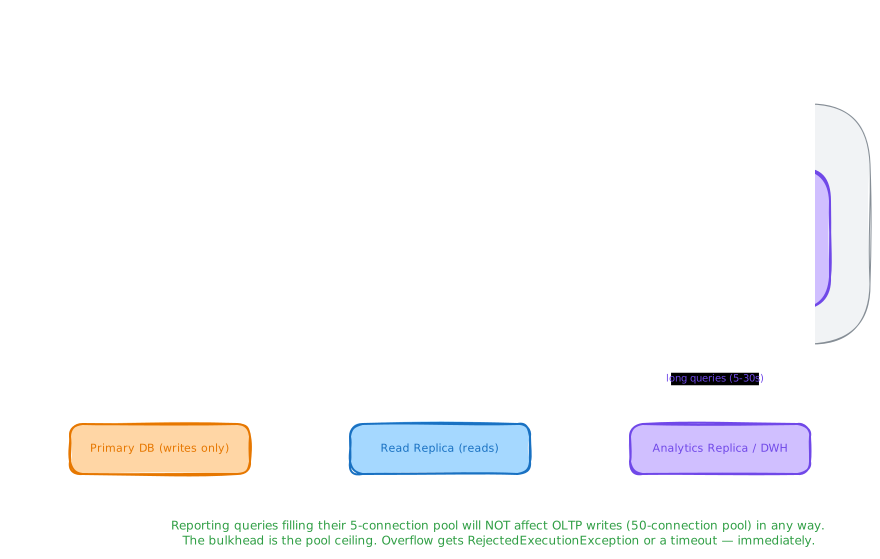
Three separate connection pools: OLTP Write Pool (50 connections to Primary DB), Read Replica Pool (100 connections to Read Replica), Analytics Pool (5 connections to Analytics Replica). Each pool is distinct with separate ceiling.
Analytics reporting queries fill their 5-connection cap at most. The OLTP write pool (50 connections) is physically separate and cannot be affected. Without this partitioning, a rogue report query can starve every write transaction.
# HikariCP configuration β€” separate pools per workload type
# application.yml (Spring Boot)

spring:
  datasource:
    # OLTP writes β€” latency-sensitive, must never be starved
    primary:
      jdbc-url: jdbc:postgresql://primary.db:5432/app
      hikari:
        pool-name: oltp-write-pool
        maximum-pool-size: 50
        minimum-idle: 10
        connection-timeout: 3000        # fail fast: 3s max wait for connection
        idle-timeout: 600000

    # User-facing reads β€” medium priority
    replica:
      jdbc-url: jdbc:postgresql://replica.db:5432/app
      hikari:
        pool-name: read-replica-pool
        maximum-pool-size: 100
        minimum-idle: 20
        connection-timeout: 5000

    # Analytics / reporting β€” low priority, can wait
    analytics:
      jdbc-url: jdbc:postgresql://analytics.db:5432/app
      hikari:
        pool-name: analytics-pool
        maximum-pool-size: 5            # hard cap: analytics never gets more than 5
        minimum-idle: 0
        connection-timeout: 30000       # analytics can wait longer
        idle-timeout: 60000

A single analytics query that runs a 30-second GROUP BY across 500M rows uses one connection for 30 seconds. With a 5-connection analytics pool, that's a maximum of 5 concurrent long-running queries β€” after which the 6th analyst gets a pool timeout, not a service outage. Without the partition, that analyst's 5 connections come from the 50-connection OLTP pool, and write transactions start waiting.

For your interview: naming the connection pool as a bulkhead boundary is the move most candidates miss. When you draw a "database pool" in your architecture, always note it's separated: write pool, read pool, analytics pool. That specificity signals you've operated systems at scale.

Container and Kubernetes Bulkheads

At the infrastructure level, bulkheads manifest as resource limits on pods and namespaces. This is how you prevent one team's batch job from starving another team's user-facing API β€” even when they share the same Kubernetes cluster.
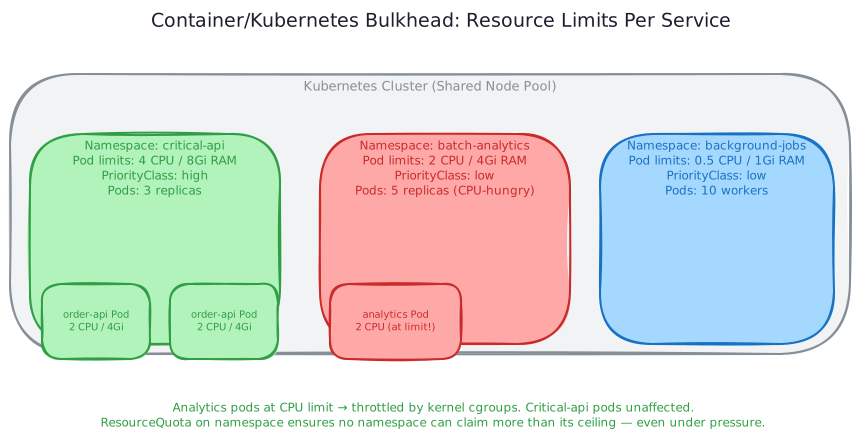
Kubernetes cluster with three namespaces: critical-api (3 pods, 4 CPU / 8Gi each, high priority), batch-analytics (5 pods, 2 CPU / 4Gi each, low priority, at CPU limit), background-jobs (10 workers, 0.5 CPU / 1Gi each, low priority).
Kubernetes namespaces with ResourceQuota enforce the bulkhead ceiling at the kernel level. Analytics pods throttled by cgroups cannot steal CPU from the critical-api namespace.
# k8s-bulkhead.yaml β€” namespace-level ResourceQuota as a bulkhead
apiVersion: v1
kind: ResourceQuota
metadata:
  name: batch-analytics-quota
  namespace: batch-analytics
spec:
  hard:
    requests.cpu: "10"         # namespace can request at most 10 CPUs total
    requests.memory: "20Gi"
    limits.cpu: "20"
    limits.memory: "40Gi"
    count/pods: "10"           # max 10 pods β€” prevents runaway horizontal scaling
---
apiVersion: scheduling.k8s.io/v1
kind: PriorityClass
metadata:
  name: critical-api-priority
value: 1000000                 # preempts low-priority pods when node is under pressure
globalDefault: false
---
apiVersion: scheduling.k8s.io/v1
kind: PriorityClass
metadata:
  name: batch-priority
value: 100                     # batch jobs can be evicted to free resources
globalDefault: false

The PriorityClass combination is the part most Kubernetes articles skip: if a node is memory-pressured, the scheduler evicts low-priority pods first. With this setup, a batch job OOMing at midnight evicts the batch pod, not the order-api pod sleeping next to it.

Multi-Tenant Bulkhead

Multi-tenant SaaS is where bulkheads become a product guarantee, not just an operational nicety. Without tenant-level isolation, one tenant running a script can degrade service for all other tenants.
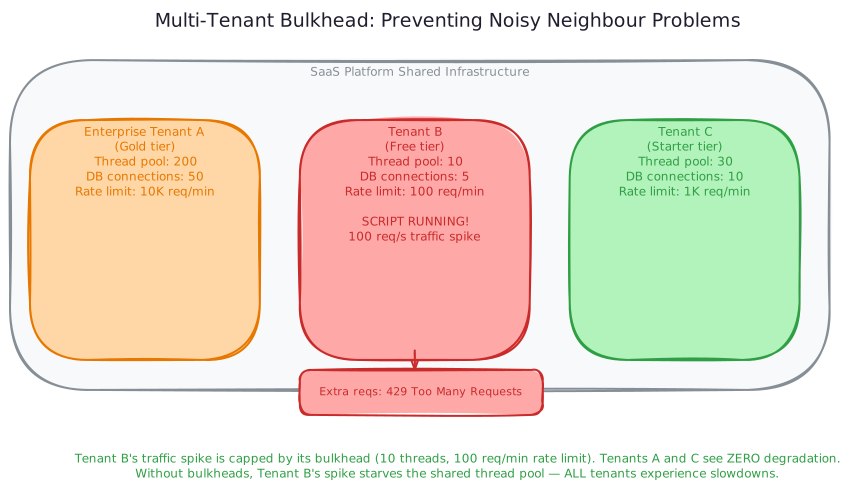
SaaS platform with three tenant compartments: Enterprise Tenant A (Gold tier, 200 threads, 50 DB connections, 10K req/min), Tenant B (Free tier, 10 threads, 5 connections, 100 req/min - running a script causing 100 req/s spike), Tenant C (Starter tier, 30 threads, 1K req/min). Tenant B's overflow gets 429 responses.
Tenant B's script floods their bulkhead. Their 10-thread pool saturates, their rate limit fires 429s. Enterprise Tenant A and Tenant C see exactly zero degradation β€” they're in separate compartments.
// tenant-bulkhead-middleware.ts
// Each tenant gets their own semaphore based on their tier
type TenantTier = 'enterprise' | 'professional' | 'starter' | 'free';

const tierLimits: Record<TenantTier, number> = {
  enterprise: 200,
  professional: 50,
  starter: 30,
  free: 10,
};

const tenantBulkheads = new Map<string, SemaphoreBulkhead>();

function getTenantBulkhead(tenantId: string, tier: TenantTier): SemaphoreBulkhead {
  if (!tenantBulkheads.has(tenantId)) {
    tenantBulkheads.set(
      tenantId,
      new SemaphoreBulkhead(`tenant:${tenantId}`, tierLimits[tier])
    );
  }
  return tenantBulkheads.get(tenantId)!;
}

// Express middleware
export function tenantBulkheadMiddleware(req: Request, res: Response, next: NextFunction) {
  const { tenantId, tier } = req.tenant; // set by auth middleware
  const bulkhead = getTenantBulkhead(tenantId, tier);

  bulkhead.execute(async () => {
    await new Promise<void>((resolve) => {
      req.on('close', resolve);
      next();
    });
  }).catch((err) => {
    if (err instanceof BulkheadFullError) {
      res.status(429).json({
        error: 'too_many_requests',
        message: 'Your request limit is currently reached. Upgrade your plan for higher concurrency.'
      });
    } else {
      next(err);
    }
  });
}

The teardown trick is the elegant part: the semaphore's permit is held for the duration of the entire request (from middleware entry to req.on('close')), not just the DB query portion. This counts concurrent HTTP requests per tenant β€” which is exactly the right unit of isolation for a noisy-neighbour problem.

API Criticality Tier Bulkhead

Not all endpoints are equal. A recommendation engine failure and a payment processor failure have very different revenue implications. Tiered bulkheads let you allocate disproportionately more resources to revenue-critical paths.
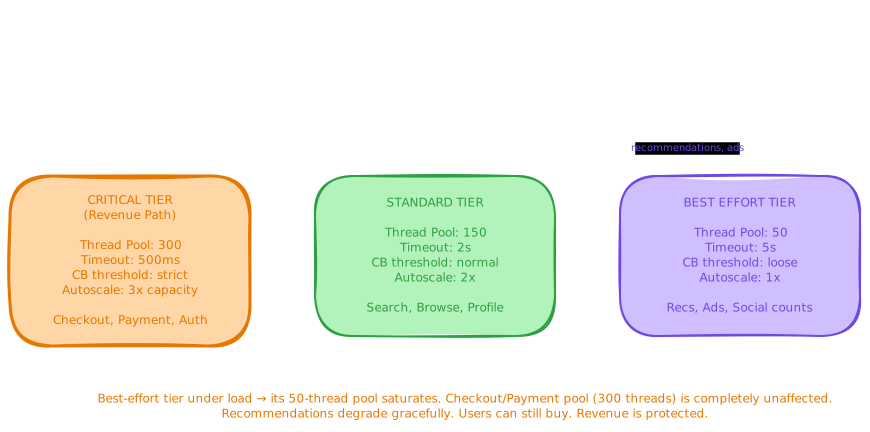
API Gateway routing to three tiers: Critical Tier (checkout/auth, 300 threads, 500ms timeout, strict CB), Standard Tier (browse/search, 150 threads, 2s timeout), Best Effort Tier (recommendations/ads, 50 threads, 5s timeout). Best effort tier can be full without affecting critical tier.
The critical tier gets 300 threads precisely because payment and checkout cannot tolerate Resource starvation. Best-effort features can degrade gracefully β€” users don't notice missing recommendations; they do notice failed payments.

I'll always sketch this exact tiering at the staff level when designing an e-commerce, streaming, or fintech system. The interviewer hears "I'm protecting revenue paths first and letting non-critical features degrade gracefully" β€” which is exactly the right prioritisation.

Implementation with Resilience4j (Production Library)

In practice, you shouldn't hand-roll bulkhead logic. Resilience4j is the standard JVM library; for Node.js, cockatiel is the production-grade choice. Here's both:

// Resilience4j (Java) β€” thread pool bulkhead
// build.gradle: implementation 'io.github.resilience4j:resilience4j-bulkhead'

ThreadPoolBulkheadConfig config = ThreadPoolBulkheadConfig.custom()
    .maxThreadPoolSize(20)          // max active threads
    .coreThreadPoolSize(10)         // always-warm threads
    .queueCapacity(10)              // buffer before rejection
    .keepAliveDuration(Duration.ofMillis(100))
    .build();

ThreadPoolBulkhead bulkhead = ThreadPoolBulkhead.of("payment-service", config);

// Usage
CompletionStage<PaymentResult> result = bulkhead.executeSupplier(
    () -> paymentClient.charge(orderId)
);

// Handle rejection
result.exceptionally(ex -> {
  if (ex instanceof BulkheadFullException) {
    // Graceful degradation: queue for retry or return pending state
    return PaymentResult.pending(orderId);
  }
  throw new CompletionException(ex);
});
// cockatiel (Node.js) β€” bulkhead + circuit breaker combined
import { bulkhead, CircuitBreakerPolicy, ConsecutiveBreaker, Policy } from 'cockatiel';

const paymentBulkhead = bulkhead(20, 10);  // 20 concurrent, 10 queued

const paymentCircuit = Policy.handleAll()
  .circuitBreaker(30_000, new ConsecutiveBreaker(5));

// Compose them: bulkhead first (resource limits), then CB (failure detection)
const paymentPolicy = Policy.wrap(paymentBulkhead, paymentCircuit);

async function charge(orderId: string) {
  return paymentPolicy.execute(() => paymentClient.charge(orderId));
}

The composition order matters: bulkhead wraps circuit breaker. You want resource limits enforced before the circuit breaker sees the call β€” if the bulkhead rejects a call, the circuit breaker shouldn't count it as a failure. A rejection due to local resource pressure is not evidence that the downstream service is broken.

Sizing Bulkheads β€” The Formula Most Guides Skip

The most common mistake I see in production is setting bulkhead sizes to round numbers β€” "20 threads feels right." That's guesswork dressed as configuration. Here's the actual formula used for thread pool sizing:

pool_size = (concurrent_requests) Γ— (avg_downstream_latency_seconds) Γ— (safety_factor)

Where:
  concurrent_requests      = your expected peak TPS for calls to that downstream
  avg_downstream_latency   = p99 latency of the downstream under normal load (in seconds)
  safety_factor            = 1.5 to 2.0 (buffer for spikes and cold starts)

Example: Your Order Service calls the Inventory Service at 500 calls/second peak. Inventory's p99 latency is 40ms (0.04s). Safety factor 1.5:

pool_size = 500 Γ— 0.040 Γ— 1.5 = 30 threads

With 30 threads, at peak load 500 Γ— 0.040 = 20 threads are in-use concurrently (Little's Law). The 10-thread buffer handles bursts. If Inventory degrades to 200ms p99, 500 Γ— 0.200 = 100 threads needed β€” the pool fills at 30, and new calls reject immediately rather than cascading. This is exactly what you want.


When It Shines

So when does this actually matter? Here's the honest answer: any time you have more than two synchronous downstream dependencies and any of them can be slow or unreliable.

Use bulkheads when:

  • Your service makes 3+ synchronous calls to different downstreams and any one of them could be slow.
  • You operate a multi-tenant SaaS and tenant fairness is part of your SLA.
  • You have workloads with very different latency profiles sharing a resource β€” OLTP + analytics, or user-facing + batch jobs.
  • You have a critical revenue path (payments, auth, checkout) that must not degrade when non-critical features slow down.
  • You're calling a third-party API with no SLA guarantees (Twilio, Stripe, OpenAI) from a latency-sensitive service.

Skip bulkheads when:

  • You have a single downstream dependency. There's nothing to isolate against.
  • Your service is purely read-through β€” each request makes one downstream call and returns. Shared-pool exhaustion requires multiple call types to exist simultaneously.
  • You're using a fully asynchronous/reactive framework (RxJava, Project Reactor, Vert.x). Backpressure is built into the programming model β€” bulkheads are less necessary, though still useful for downstream isolation.
  • You're in a monolith with no remote calls. Bulkheads protect against network-bound resource exhaustion; no network = no bulkhead benefit.

The rule of thumb: 3+ synchronous downstream dependencies = you probably need bulkheads. Two or fewer, verify first. One monolith with one DB doesn't need this.


Failure Modes & Pitfalls

1. Pool sized too small β€” false positives under normal load

A payment pool of 5 threads at a service doing 200 payment calls/second with 50ms payment latency needs 200 Γ— 0.050 = 10 threads at steady state. Your 5-thread pool will reject 50% of calls during normal operation β€” not only during degradation. This looks like "the circuit breaker is too sensitive" but the real culprit is an undersized bulkhead.

I'll often see teams blame the circuit breaker when the bulkhead is the root cause β€” always trace rejections back to which bulkhead fired before concluding the downstream is broken.

2. Pool sized too large β€” defeating the purpose

A payment pool of 5,000 threads defeats the isolation goal. If the downstream hangs, 5,000 threads block, each consuming ~1MB of stack memory β†’ 5GB of memory consumed by one slow dependency. You've not limited blast radius; you've just moved the resource exhaustion from CPU/thread-count to heap memory.

Size pools to prevent cascade. 20–50 threads per downstream is the normal range for most services; recalculate using Little's Law.

3. Missing queue depth cap β€” silent unbounded backlog

Thread pool bulkheads often have a task queue that buffers submitted work when all threads are busy. If this queue is unbounded, the bulkhead becomes ineffective: calls don't reject β€” they pile up in the queue indefinitely. Memory grows. Latency grows. When the downstream finally times out, all queued calls fail simultaneously in a cascade no different from the original problem.

Always set queueCapacity explicitly. Resilience4j ThreadPoolBulkhead defaults to Integer.MAX_VALUE β€” you must override this. A queue of 2Γ— pool_size is a reasonable starting point.

4. Ignoring the reject path β€” user sees a generic 500

A bulkhead that fires a BulkheadFullException is only useful if your application catches it separately from genuine downstream failures. If your catch-all exception handler returns a generic 500, users get the same bad experience as without the bulkhead β€” just faster.

The reject path should do something useful: return a stale cache value, return a degraded response, or return a clear 503 with a Retry-After header. My recommendation is to define the fallback before you configure the bulkhead.

5. Bulkhead without observability β€” invisible rejections

If your bulkhead is silently rejecting 5% of calls and you have no metric on it, you're serving degraded responses to 1 in 20 users without knowing. Track bulkhead_rejected_total{service="payment"} and alert if rejection rate exceeds 1% of calls. That single metric is the early warning for an undersized pool or a degrading downstream.


None of these are theoretical β€” every one of them has paged engineers at 2 a.m., and every one of them was preventable.

Why You Need Both: Bulkhead + Circuit Breaker

Bulkheads and circuit breakers solve different parts of the same problem. If you only remember one pairing from this article, make it this one: they must be used together.

flowchart TD
  subgraph CallerService["βš™οΈ Caller Service"]
    IncomingReq(["πŸ‘€ Incoming Request"])
    BH["πŸͺ£ Bulkhead\n(Thread Pool / Semaphore)\nResource limit enforced here"]
    CB["⚑ Circuit Breaker\nFailure rate detected here\nOpen state: fail-fast"]
    Fallback["πŸ”„ Fallback\nStale cache / degraded response"]
  end

  subgraph DownstreamSvc["πŸ—„οΈ Downstream Service"]
    DS["Payment / Inventory / Auth\n(Potentially slow or broken)"]
  end

  IncomingReq -->|"request enters"| BH
  BH -->|"permit granted"| CB
  BH -->|"pool FULL β†’ reject"| Fallback
  CB -->|"CLOSED: forward call"| DS
  CB -->|"OPEN: fail-fast"| Fallback
  DS -->|"failure Γ— 5 β†’ CB trips"| CB
  DS -->|"response"| IncomingReq

Bulkhead handles: How many concurrent calls reach the downstream. Caps resource consumption in your process.

Circuit breaker handles: Whether calls should be attempted at all based on the downstream's failure history. Protects the downstream from overload during recovery.

Without the bulkhead, a degraded-but-open circuit can still exhaust your thread pool waiting for 29.9-second responses (just under the 30s timeout). The thread pool fills, even though each individual call eventually resolves.

Without the circuit breaker, a full bulkhead just means 20 threads stuck waiting with no fast detection that the downstream is broken. You need both.


Trade-offs

BenefitCost
Contained blast radius β€” one slow dependency cannot exhaust threads for unrelated featuresPre-allocated pools sit idle when their workload is light β€” you always "waste" some capacity
Predictable worst-case performance β€” bulkhead full means immediate rejection, not indefinite queueingSizing requires knowing your TPS and downstream latency β€” wrong sizes cause false rejections or wasted threads
Multi-tenant fairness guaranteed at the resource layer, not just the routing layerThread pool isolation adds ~1–3ms context-switch overhead per call β€” non-trivial at 50K req/s
Enables graceful degradation β€” non-critical features shed first, revenue paths protectedIncreases operational surface: N downstream services = N bulkhead configs to tune and monitor
Forces explicit failure handling β€” the reject path must be designed, not discovered in productionBulkhead rejection and genuine downstream failure look identical if you don't separate exception types

The fundamental tension here is resource efficiency vs. isolation. Every thread or permit reserved for one dependency is one that cannot absorb a spike from another. You are paying in idle capacity to buy guaranteed fault containment.


Real-World Examples

Netflix β€” the origin of bulkheads in software

Netflix coined the term "bulkhead" in the software context when they documented the Hystrix library in 2012. Before Hystrix, their recommendation service hanging would cascade through the API gateway to every endpoint β€” a "total site failure" from a single non-critical feature. Their core insight: every Hystrix command ran in its own named thread pool. The recommendation engine had 50 threads; payment had 100; user profile had 30. A full recommendation pool resulted in degraded homepages but fully functional playback. Netflix published that Hystrix prevented thousands of total-cascade events per day across their microservice fleet, each of which would have been a multi-minute full outage under the pre-Hystrix architecture.

The non-obvious lesson: Netflix's decision to use thread pool isolation (instead of semaphores) was deliberate. Their recommendation calls made external HTTP calls with unpredictable latency. Semaphore isolation would have blocked the caller thread; thread pool isolation gave a clean timeout boundary at the executor queue.

Amazon β€” checkout SLA budgeting

Amazon designs their checkout critical path with explicit resource allocation per dependency. From published architecture talks: checkout, cart, and payment services are allocated dedicated resources on fixed capacity, isolated from experimental features. This isn't just bulkheads in code β€” it's separate service instances, separate auto-scaling groups, and separate DB connection pools. When "also bought" recommendations start doing expensive ML inference and slow down, checkout throughput is unaffected. The revenue-critical path has its own bulkhead at the infrastructure level. Amazon values their checkout latency at millions of dollars per 100ms β€” the resource allocation to protect it reflects that math.

Stripe β€” per-API-key rate limiting as a tenant bulkhead

Stripe's API enforces per-key rate limits: each API key (representing a merchant integration) gets its own request quota. This is a semaphore bulkhead at the tenant level β€” one large merchant running a reconciliation script can saturate their own rate limit without degrading Stripe's capacity for other merchants. Stripe's engineering posts document that without per-key limits, large merchants would consume the entire worker pool during batch operations, spiking error rates for small merchants. The bulkhead is product-level: each merchant's isolation is part of their SLA.


How This Shows Up in Interviews

Here's the honest answer: bulkheads are underrepresented in interview prep, which makes naming them correctly a real differentiator. When you draw a microservices architecture and an interviewer asks "what happens if the Payment Service goes down?" β€” "we add a circuit breaker" is expected. "We add thread pool isolation per dependency so payment failures are contained to the payment bulkhead" is senior-to-staff.

My recommendation: as soon as you draw two or more synchronous service-to-service calls, say "I'll add a bulkhead on these outbound calls β€” dedicated thread pool or semaphore per downstream β€” so a slow payment service can't exhaust threads for the inventory and auth calls." One sentence. Then pair it with the circuit breaker and move on.

When to bring it up proactively

Mention bulkheads alongside circuit breakers as a pair. Say: "I'll bulkhead all outbound calls with separate thread pools β€” 20 threads max per downstream β€” and wrap each pool with a circuit breaker. Bulkhead limits blast radius inside this service; circuit breaker limits blast radius across the mesh." The combination shows you understand what each pattern protects at which layer.

Depth expected at senior/staff level:

  • Explain the difference between semaphore and thread pool isolation β€” when to use each.
  • Name the sizing formula: pool_size = TPS Γ— latency Γ— safety_factor. Compute it live. This is the #1 differentiator.
  • Explain why bulkhead and circuit breaker must be composed together, and the correct order (bulkhead wraps CB).
  • Describe connection pool bulkheads β€” write pool, read pool, analytics pool β€” as a distinct pattern worth naming.
  • For multi-tenant systems: tenant-level semaphores per tier as a product-level isolation guarantee.

The thing most people miss in interviews

When asked "what's the thread pool size?" almost everyone says "I'd tune it based on load." That's a non-answer. Say: "I'd size it using Little's Law: pool_size = TPS Γ— avg_latency Γ— 1.5. At 200 calls/second to a 40ms dependency, that's 200 Γ— 0.04 Γ— 1.5 = 12 threads. I'd alert when pool utilisation exceeds 80% β€” above that, you're one latency spike away from full rejection."

Common follow-up questions and strong answers:

Interviewer asksStrong answer
"What's the difference between a bulkhead and a circuit breaker?""Bulkhead limits how many concurrent calls can run β€” it's a resource cap inside your process. Circuit breaker limits whether calls should be attempted at all β€” it's a historical failure rate detector. Bulkhead fires immediately when permits are exhausted. CB fires after N failures over a time window. Both are needed: bulkhead stops resource flood, CB stops repeated attempts on a broken downstream."
"How do you size a bulkhead?""Little's Law: pool_size = TPS Γ— avg_latency Γ— safety_factor (1.5). At 300 TPS to a 60ms downstream: 300 Γ— 0.060 Γ— 1.5 = 27 threads. I'd round up to 30, set queue depth to 60, and alert at 80% utilisation."
"What happens when the bulkhead rejects a call?""The caller gets a BulkheadFullException. That must be caught and handled differently from a downstream 500 β€” it means local resource pressure, not a broken external service. Typical response: return a stale cache value if available, else return a 503 with Retry-After, and never bubble it up as a generic error."
"Should I use semaphore or thread pool bulkhead?""Thread pool for: slow synchronous I/O where you need independent timeout enforcement (external HTTP, DB queries with unpredictable latency). Semaphore for: fast-fail concurrency capping where you just want to bound concurrent in-flight calls, async-friendly runtimes, and low overhead. Resilience4j defaults to semaphore β€” you have to opt into thread pool explicitly."
"How do you prevent bulkhead misconfiguration from causing false rejections?""Instrument it. Track bulkhead_rejected_total per service. If rejection rate > 0 under normal load, the pool is undersized. If utilisation never exceeds 30%, the pool is oversized and wasting thread resources. Treat the utilisation histogram as a first-class SLO metric, not a fire-and-forget config."

Know these cold β€” the sizing question in particular comes up whenever you mention bulkheads and signals whether you've actually operated the pattern or just read about it.


Test Your Understanding


Quick Recap

  1. The bulkhead pattern partitions shared resources (threads, connections, semaphore permits) into isolated compartments per dependency or tenant β€” preventing exhaustion in one compartment from cascading to others.
  2. Thread pool isolation assigns a fixed executor per downstream; semaphore isolation caps concurrent permits per feature β€” choose thread pools when you need timeout enforcement on slow I/O, semaphores when overhead matters and calls are fast.
  3. The correct pool size comes from Little's Law: pool_size = TPS Γ— avg_latency Γ— 1.5 β€” anything else is guesswork. Compute it live in interviews.
  4. The most dangerous misconfiguration is an unbounded task queue (queueCapacity: MAX_VALUE) β€” it converts a bulkhead into a memory leak that OOMs under extended outage.
  5. Pair bulkheads with circuit breakers as a composed policy: bulkhead wraps circuit breaker, because the bulkhead provides flow control during the HALF-OPEN recovery window that the circuit breaker alone cannot.
  6. Connection pool partitioning (write pool, read pool, analytics pool) is the most commonly missed bulkhead in production systems β€” and the one directly responsible for "why did analytics take down OLTP writes?"
  7. In interviews, naming the sizing formula and explaining the bulkhead + circuit breaker composition order separates senior-level answers from staff-level ones.

Variants

Retry + Bulkhead: A retry policy inside a thread pool bulkhead can cause unexpected pool saturation β€” each retry holds a thread for the retry duration. Always place retries inside the bulkhead (so retries are bounded by the pool) or ensure retry backoff is long enough to release the thread between attempts.

Adaptive bulkhead: Some systems dynamically adjust pool sizes based on observed utilisation β€” expanding during peak and shrinking during off-peak. Resilience4j does not support this natively; you'd build it with metrics-driven reconfiguration. Useful for highly spiky workloads where static sizing wastes headroom 80% of the time.

Priority-weighted bulkhead: Instead of equal-partition pools, assign priority weights to workloads sharing a pool. Emergency health-check calls get 10 high-priority permits; background sync gets 2 low-priority permits. Useful when a strict pool-per-feature is impractical (too many features to enumerate individually).


Related Patterns

  • Circuit Breaker β€” The natural partner: circuit breaker detects failure history and stops calls; bulkhead limits concurrent call volume. Use both together for a full resilience envelope.
  • Rate Limiting β€” Rate limits control throughput over time (req/s per user); bulkheads control concurrent capacity (in-flight requests). Both limit resource consumption but at different dimensions β€” time-based vs. concurrency-based.
  • Microservices β€” The architectural context where bulkheads become mandatory. Moving from a monolith to microservices introduces network-bound thread blocking that doesn't exist in-process β€” bulkheads are the answer.
  • Service Mesh β€” Istio and Linkerd can enforce outlier detection and concurrent request limits at the sidecar proxy layer β€” infrastructure-level bulkheads that don't require code changes. Know the tradeoff: less flexibility in fallback logic, but language-agnostic.
  • Caching β€” A stale cache is the correct fallback when a bulkhead or circuit breaker fires. Design the fallback before you add the pattern: "what does the user get when the payment bulkhead is full?" If the answer is a stale last-known value from cache, cache design is prerequisite.

Previous

Circuit breaker pattern

Next

CQRS (Command Query Responsibility Segregation)

Comments

On This Page

TL;DRThe ProblemOne-Line DefinitionAnalogySolution WalkthroughThread Pool IsolationSemaphore IsolationConnection Pool BulkheadContainer and Kubernetes BulkheadsMulti-Tenant BulkheadAPI Criticality Tier BulkheadImplementation with Resilience4j (Production Library)Sizing Bulkheads β€” The Formula Most Guides SkipWhen It ShinesFailure Modes & Pitfalls1. Pool sized too small β€” false positives under normal load2. Pool sized too large β€” defeating the purpose3. Missing queue depth cap β€” silent unbounded backlog4. Ignoring the reject path β€” user sees a generic 5005. Bulkhead without observability β€” invisible rejectionsWhy You Need Both: Bulkhead + Circuit BreakerTrade-offsReal-World ExamplesHow This Shows Up in InterviewsTest Your UnderstandingQuick RecapVariantsRelated Patterns